Lorem ipsum dolor sit amet, sapien platea morbi dolor lacus nunc, nunc ullamcorper. Felis aliquet egestas vitae, nibh ante quis quis dolor sed mauris. Erat lectus sem ut lobortis, adipiscing ligula eleifend, sodales fringilla mattis dui nullam. Ac massa aliquet.
1995 HONDA ST1100
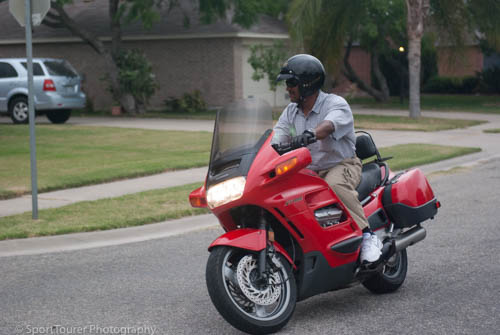
As its name implies, the Honda ST design is an excellent compromise between Sport and Touring styles of motorcycle riding.
Many types of motorcycles “come and go” as rapidly as advancing technology creates and makes them obsolete.
But every once in a while in the life of motorcycle design, a model appears that gives the marketplace exactly what it wants, makes it’s mark and hangs around for a relatively long time by virtue of its concept.
The Honda ST1100 is one such machine.
Honda “got it” so right with the design of the ST1100’s V4 engine, that from its model year inception in 1989, there were practically no major changes until 2002.
Over its 12-year run the ST1100 more than proved itself to be the “King of the Sport Tourers”. It has justifiably gained a solid reputation of being an extremely reliable machine that just quietly gets on with its business at hand – a trademark of Honda that the world has come to know of it’s machines and a reputation that they still enjoy to this day. This same reputation has been handed down to its very capable successor. They “raised the bar” with the upgrade to the ST1300, much to the surprise of the dedicated ST owners and followers (myself included) who did not, in my wildest imagination, think that the ST1100, needed or would ever see as much dramatic change.
ST owners such as myself are a very dedicated and loyal group to this machine for very specific reasons.
The design concept of the ST model was based primarily on satisfying the European riding market.
European riders were looking for features in a bike that would satisfy their need for long distance travel, with decent luggage carrying capacity at high speed and in comfort.
They wanted a big, supremely comfortable, easy-handling machine with which they could cross Europe easily, without being constrained to a huge luxury-cruiser such as the Gold Wing, or a tiny, fast sport bike in the “ninja” class.
Honda listened and so the ST line came about.
Unsurprisingly, they named it the “Pan European” (Specifically for the European market). It actually debuted a year before being available for the American market where it was then named the “ST1100”.
SPECIFICATIONS.
Make & Model: 1995 Honda ST1100
Type: Sport Tourer
Production Years: 1989 to 2002
Engine /Capacity: Liquid cooled, 4 cylinder V4 configuration, Transversely mounted 1084 cc displacement.
Final Drive: Shaft
Frame: Tubular frame.
Brake Horsepower: 100 bhp @ 7500 rpm
Torque: - 75 lb.ft @ 6500 rpm
Weight: 290kg/638 lbs. (dry)
Fuel Capacity: - 28 liters/7.4 US Gal.
Top Speed: I don’t know, I don’t care to know, but its definitely way more than I care to attain!
Tank Range: Average 300 miles/480 km. on a full tank at an average speed of 65 m.p.h. (104 km/h) and little to no headwind.
Front Brakes: Nissin Twin discs. 316 mm dia. ea. Dual-piston Calipers. Hydraulically operated.
Rear Brakes: Nissin single disc. 316 mm. dia. Dual-piston Caliper. Hydraulically operated.
My Choice and Size of Front Tire: Metzeler Lasertec 110/80 ZR18 58W rating.
My Choice and Size of Rear Tire: Michelin Pilot Road 4 GT(PR4 GT) 160/70 ZR17 72W rating.
Alternator/Charging System: 336 Watts. Inadequate and problematic, but upgradeable to a 480-watt unit.
Lighting: Twin halogen beam headlights. 45/40Watts hi/lo beam.
So if you’ve read my journal entitled “The Early Years 2”, you will know how the Honda ST1100 model found its way into my motorcycling life.
ENGINE AND FRAME.
The classic V4 engine is superbly smooth!
Cylinder arrangement has each pair at 90 degrees to each other, transversely mounted on the steel tubular frame, sticking out and giving it the V4 configuration when viewed from the front.
This layout gives the bike very good balance and allows for a low center of gravity.
4 Constant Velocity carburettors (british spelling) each with a 34.5mm bore, one feeding each cylinder, are mounted in the “vee-well” of the engine, hidden from view.
The camshafts are driven by belt which results in a super quiet engine valve train.
This really minimizes noise fatigue on those long drawn out rides/journeys.
Being a belt, it becomes extremely important to replace it at the required/recommended interval as determined by the manufacturer in the maintenance schedule. Consequences of failing to do this could result in very expensive damage to engine valves, pistons, cylinder head/combustion chamber etc etc. in short, possible catastrophic engine failure at the worst.
So be warned.
Should you purchase a used one for yourself, take my advice and do like I did - regardless of the bike’s physical condition and appeal, go ahead and replace that item with a brand new OEM replacement.
Engine output is delivered to the final drive gear by shaft, through a wet-type multi-disc clutch and basket, which, on mine, I replaced with an aftermarket (EBC brand) replacement. This eliminated the familiar faint rattling sound of a well-used clutch of this type, which my “mechanical ear” did not miss.
Simplistic in design, the drive shaft retains a little bit of the characteristic “jacking up” of the rear end under high power loading to the rear wheel.
Not terribly noticeable but technically present.
Unless one pays attention to it, you may not even notice it.
At 155 inches (394 cm) of wheelbase, she is a long machine. This makes for a very planted ride but relatively “slow steering”.
It is here that it delivers a supremely comfortable and stable ride on long straight run outs of open highway allowing you to sustain high speeds in great comfort.
There’s no guesswork here. She remains well planted and rock steady.
Windshield.
The fixed windshield can be somewhat annoying as each rider will have a different requirement in height settings. This factor has caused a lot of other owners of this machine that I know to replace the original with an aftermarket one to suit their particular needs.
In my case, the upper lip of the windshield was right at my eye level, forcing me to either look down through the shield and not see far ahead enough, or look over it and catch the breeze full in my face creating neck strain from trying to forcibly keep my head steady.
somehow or other though, I soon forced myself to deal with it.
Handlebars/Steering.
Low-slung and weighted, they create more of a neutral seating/riding position on the bike which suits me very well, although i cannot say much the same for others who have and prefer a different riding position.
One improvement I made which was really worthwhile, was to replace the steering-head bearings.
The original ones tend to create flat spots in their “races” causing notches and rough spots in the steering action.
I replaced them to tapered roller types (upper and lower) and this made a world of difference to the steering/handling performance of the bike. It was like night and day!
Again, this is a procedure that I would highly recommend.
Whilst at that, I refreshed the front fork suspension oil and rebuilt/overhauled the anti-dive valve located on the left front fork.
Seat.
Mine came equipped with a Corbin custom seat.
Although pretty worn with minor tears in the leatherwork, I came to really like and enjoy this one-piece seat. After a few months of ownership I had it re-upholstered, restoring it to almost brand new status.
The many long miles of touring on this seat were extremely comfortable, erasing all signs of “butt-fatigue” - well worth the expense I made!
Panniers.
The detachable function of the bags/panniers is a great feature.
Arriving at each daily destination when on tour, the ease of removal eliminates the need for rummaging through luggage before locking down for the night.
The turn of a keyed lock and the release of a latch is all it takes to remove each bag. And with a sturdy handle built in, is all you need to carry the bags into your room.
At 35 liters of volume, they are each cavernous enough to hold an XL-sized full face helmet and a host of other gear.
They are lockable and share the same key with all other locks on the bike.
So with these “simple-to-me” maintenance/repair procedures, I brought my bike into pretty good mechanical condition, ready for the open road that lay ahead of me.
Tires.
Pretty much a matter of choice that suits you.
Over the time of ownership I tried and went through a couple of sets of different tires and finally settled on an Avon Storm 2 for the rear in combination with a Metzler Lasertec on the front.
The tire size requirements for this bike are not common and this factor limits you to your choice of tires available on the market. I like to think that the manufacturer intentionally designed it this way to be sure that the tires you get would meet the required load ratings.
The Avons were an excellent wet and dry weather tire, with good grip all around, only to the point that the front tire sidewalls were not stiff enough to adequately handle the weight load and forces generated when all that mass was transferred to the front upon deceleration/slowing down. This created a front end wallowing/wobbling effect.
The front Lasertec (Metzler) addressed this issue for me and also gave excellent grip for braking and great water dispersal due to the Sipe (grooves/tread pattern) design.
This combined with the rear Avon Storm tire and its great wet weather handling quality and characteristics rounded off the package for me, complimenting my style of riding.
LIGHTING.
With a 28 amp alternator and 45-watt twin bulb headlamp, the lights on this machine were woefully inadequate.
Since I did not have any external electrical accessories to draw extra power, I upgraded my bulbs to 55/45-watt (hi/lo) bulbs. This ensured that the alternator output would be sufficient to handle the increased current draw.
Requiring a little bit of modification to fit standard (non-OEM) bulbs, I was able to make an adapter to accommodate the differently angled/placed position tabs into the light assembly without the need to modify anything else, keeping it all “stock” (as-built from factory) - a great improvement in light intensity and output.
Additionally, being a relatively aged machine, I went through every plug connector and negative cables in the wiring harness and cleaned up and ensured good electrical integrity of the electrical system.
Brakes.
The braking system on this bike is a straightforward hydraulically operated system.
Twin 316 mm discs up front and single one, similarly sized at the rear, are “clamped” by dual piston calipers resulting in excellent capacity to bring this heavy machine to a quick stop.
The absence of ABS requires good habits and skill to avoid locking-up the wheels, especially in inclement weather.
The only upgrade I made to this system was to replace a badly worn rear brake disc and install my brake pads of choice (EBC brand).
Final Drive.
Another very important thing I did was to replace all five rubber bushes and drive pins in the final drive assembly.
It needed it.
These worn out pins and bushes make for a harsh gear change, especially when shifting into first gear at initial take off or when “changing down” into higher gear whilst underway.
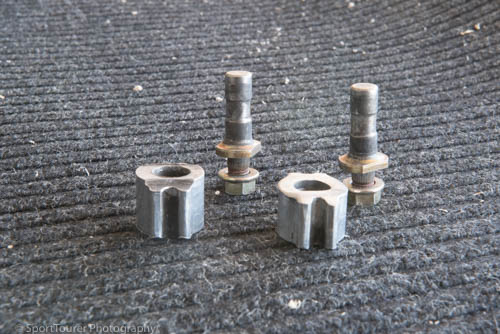
A pair of seriously worn out Drive Pins and Bushes
So with these few but major mechanical changes/upgrades, I now had myself an ST1100 in great/good mechanical and reliable condition, ready for the good times ahead!
And for the next 36,000 miles (57,600 km) of ownership, I enjoyed nothing but trouble-free riding.
Exactly what this machine was built to deliver and exactly what I wanted!
It reigned in this class, set the standard that all the other brands/manufacturers aspire to, and in 2002 after 12 years, handed the baton over to its more-than-capable successor, the ST1300 which has now raised the bar even higher.
The ST1100 (and the ST1300 in its wake), is a no-frills, no-chills machine that just gets on with the job it was designed to do.
That is to transport you, the rider, over great distances at sustained high speed, reliably, economically and in great comfort!